What is Information Gain in SEO? (And How to Add It)
Written by Habib Ur Rehman • Last Updated: November 11, 2026

Quick Summary: Information Gain is a concept where Google compares your content to the other pages ranking for the same query to see if you provide new, unique information. If you just repeat what everyone else says, your Information Gain is zero. To win in 2026, you need to add original data, first-hand experience, and expert insights that cannot be found anywhere else. This guide explains Google's Information Gain patent and gives you a step-by-step plan to add unique value to your content.
Hello! Have you ever written a perfect article, optimized it with the right keywords, built backlinks, but still found yourself stuck on page two of Google? You might be suffering from a lack of Information Gain.
In the old days of SEO, if you wrote a longer article than your competitor, you would often win. But in 2026, length means nothing. Google has become incredibly smart at understanding the meaning of words. It can read ten articles and see that they all say the exact same thing. If your article is just a summary of what is already on the internet, why should Google rank you above the others?
Google wants content that adds something new to the conversation. It wants pages that fill the gaps in existing knowledge. This concept is called Information Gain. In this detailed guide, I will explain exactly what it is, how Google measures it, and how you can use it to outrank your competitors.
What is Information Gain?
Information Gain is a way for search engines to measure how much new and unique information a specific web page provides compared to the other pages ranking for the same search query.
Think of it like a classroom assignment where five students have to write about the history of the internet. If four students write the exact same dates and facts, but the fifth student includes an interview with someone who helped build the first router, that fifth student has high Information Gain. They added something new that no one else had.
Google uses this principle to evaluate your content. If your page is the exact same as the top 10 results, Google might decide that adding your page to the top 10 provides no value to the user. They have already seen that information. But if your page adds a new statistic, a different angle, or original research, Google will rank you higher because you are offering something new.
The Science Behind It: Google's Patent
This is not just a theory. Google actually has a patent for it. In 2018, Google was granted a patent titled "Information gain based on search result diversity." The patent, which was filed in 2015, describes a system where Google calculates the information gain of a document by comparing it to a set of other documents.
According to the patent, Google calculates the overlap between the terms and entities in your document and the terms and entities in the current search results. If your document contains the same terms and entities, the information gain is low. If your document contains new terms and entities that are not present in the other documents, the information gain is high.
There are two key factors that can reduce your Information Gain:
- Repeating common knowledge: If you write about the definition of SEO, you are repeating what millions of other pages already say. Your information gain is zero.
- Using the same entities: If your article about "The Eiffel Tower" only mentions the same facts (built in 1889, height 330m, architect Gustave Eiffel), you are not adding new information.
To increase your score, you need to introduce new entities and new concepts that are relevant to the topic but not present in the top results.
Why is Information Gain So Important in 2026?
Information Gain has always been important, but it is absolutely critical in 2026 for three main reasons:
1. The Rise of AI Content
AI tools like ChatGPT have flooded the internet with generic content. If you ask ChatGPT to write an article about "how to start a blog," it will give you the exact same ten steps it has been trained to give everyone else. Google is aware of this. Its algorithms are now trained to identify and penalize AI content that lacks original value. Information Gain is how Google separates real experts from AI writers.
2. Helpful Content Update
Google's Helpful Content System rewards content that is written by people, for people. The system looks for "first-hand experience" and original insights. This is exactly what Information Gain is. If you can prove you have actually used a product or conducted a test, you gain information that Google values.
3. The Need for Factual Data
With AI generating answers, users are increasingly relying on Google to provide accurate information. Google needs sources it can trust. If your page provides original statistics, case studies, or expert quotes, it becomes a valuable source for the AI. This means your content gets cited in AI Overviews, which is the new way to win in SEO.
How to Measure Your Information Gain
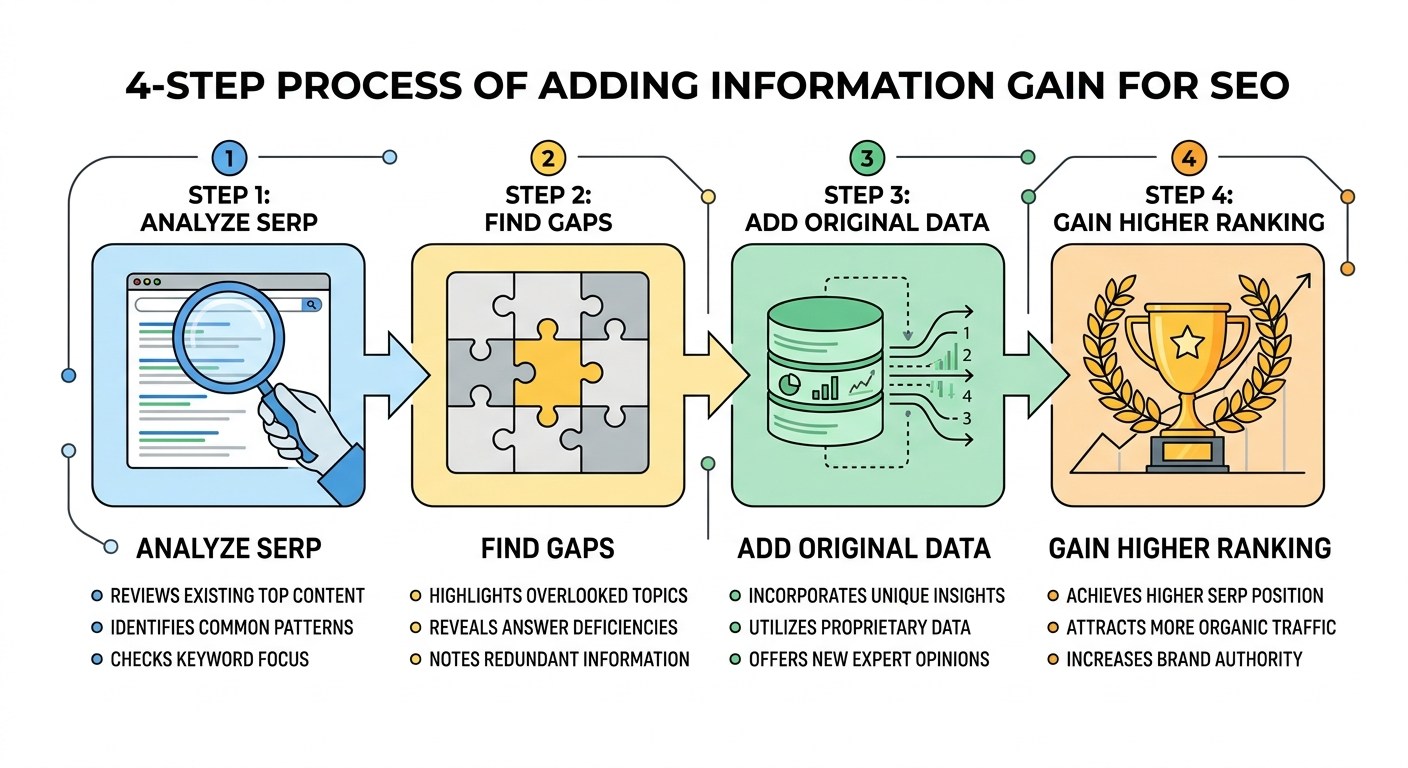
Before you can add Information Gain, you need to measure what is already out there. You need to do a competitor analysis to find the gaps.
Here is how to do it:
- Search your target keyword on Google: Look at the top 10 results. Read the articles or use a tool like Surfer SEO to analyze their content.
- Identify the common topics: What are all 10 articles talking about? Write down the main points they cover.
- Find the gaps: What are they missing? Is there a question they don't answer? A demographic they ignore? A different perspective?
- Use Google Search Console: Look at your own data. What queries are you ranking for on page 2 or 3? This often indicates an unmet need.
Once you have identified the gaps, you need to fill them. Here are the most effective ways to do that.
6 Ways to Add Information Gain to Your Content
There are several proven tactics to add unique value to your article. You do not need to do all of them in every article, but you should use at least one or two.
1. Add Original Data and Statistics
This is the most powerful way to add Information Gain. If you run a survey, analyze data, or conduct an experiment, you have information that no one else has. Even small data sets can be powerful. For example, if you are writing about "the best email marketing tools," you could survey 50 users to see which one they prefer. This data makes your article unique.
2. Share First-Hand Experience
Google loves real experience. If you are reviewing a product, include your own photos, screenshots, and videos. Talk about the pros and cons you experienced. Did the software crash? Did the shoes wear out quickly? This information cannot be found on the manufacturer's website, and AI cannot guess it.
3. Interview an Expert
Reach out to someone in your industry and ask them a few questions. A direct quote from an expert adds credibility and new insights that generic articles lack. Even a 3-minute phone interview can provide enough information to add significant Information Gain.
4. Include Real Case Studies
Theory is good, but real results are better. If you write a guide on "how to get more traffic," include a case study of a real website you helped. Show the traffic graph before and after. This is highly valuable to users and search engines.
5. Address a Different Audience
If all the articles on page one are for beginners, write an article for advanced users. If they are for businesses, write one for individuals. By changing the perspective, you automatically add new information that is not covered in the top results.
6. Use Unique Visuals
Do not just use stock photos. Create your own infographics, charts, and diagrams. Custom visuals add value and are often cited by other websites, which builds your backlinks. You can use our Image Compressor to ensure your visuals are fast-loading.
Information Gain vs. Topical Authority
You might be wondering how Information Gain relates to Topical Authority. They are related but different.
Topical Authority is about covering a large number of related topics on your website. For example, writing 20 articles about SEO to show Google you are an expert. Information Gain is about the depth of a single article. It is about making that one article better than any other article on the internet.
A strong website has both. It covers a wide range of topics and each article contains unique data.
Common Mistakes That Kill Your Information Gain
- Writing just to fill word count: If you add fluff just to reach 2000 words, you are not adding information. You are adding noise.
- Using AI without editing: AI models recycle information. If you publish raw AI output, your information gain is near zero. Use AI for outlines, but add your own unique data.
- Ignoring the search intent: If the user wants a quick answer and you give them a 4000-word essay with no clear answer, you are providing information but no gain.
- Copying data from other sites: If you pull statistics from another article without adding new context or interpretation, you are not adding value.
A Note from the Developer
"I used to write articles that were just longer versions of what was already ranking. I thought length was all that mattered. But my traffic plateaued. Then I started doing something different. I started adding a 'My Experience' section to every article, with my own screenshots and data. I also started including a short quote from a fellow developer in each post. The result was shocking. My pages started ranking higher because Google saw that I was adding new information to the conversation. Information Gain is the hidden ranking factor that most people ignore." — Habib Ur Rehman
The Step-by-Step Plan to Add Information Gain
Here is a simple checklist you can follow for every article you write from now on.
- Analyze: Look at the top 3 results for your keyword. What are they missing?
- Brainstorm: How can you add unique value? (Data, experience, expert quote, case study).
- Create: Do the research, run the survey, or take the screenshots.
- Write: Include your unique information in a dedicated section or spread it throughout the article.
- Highlight: Use bold text, bullet points, and tables to make your unique data stand out.
Frequently Asked Questions (FAQ)
What is Information Gain in SEO?
Information Gain is a concept where a search engine compares your content to the other pages ranking for the same query to see if you provide new, unique information. If you just repeat what everyone else says, your Information Gain is zero.
How does Google measure Information Gain?
Google's patent uses a mathematical concept called entropy to measure how much new information a page adds to the current search results. It looks for unique entities, fresh data, and original insights.
Can AI-generated content have high Information Gain?
Usually, no. AI models are trained on existing data, so they tend to produce the same generic information. To get high Information Gain, you need first-hand experience, original testing, or new data that AI cannot generate.
Does Information Gain mean I should write longer articles?
No. Information Gain is about quality, not quantity. A 1000-word article with original data can have much higher Information Gain than a 3000-word article that just repeats common knowledge.
Conclusion
Information Gain is the secret to ranking in 2026. It is no longer enough to just write about a topic. You have to add something new to the conversation. Whether it is a unique statistic, a personal story, or an expert quote, you need to give Google a reason to rank you above the already existing pages.
Start looking at your top competitors. Find the gaps. Fill them with your own unique data and experience. The websites that do this will thrive; the ones that keep writing generic content will fade away.
If you want to check your site's technical health while you build your authority, use our free Speed Checker and Broken Link Checker. Happy optimizing!
Sources & References
- Google Search Central (May 2026): Official guide on AI features and your website. Read Official Guide
- Search Engine Land: Coverage of the November 2026 Core Update rollout and Query Fan-Out. Read Report
- Google I/O 2026 Announcement: Details on Gemini 4 Carbon and AI Mode updates. Read Announcement
- Contently (2026 Study): Data on the overlap between top 10 rankings and AI Overview citations. View Study
Explore More Free SEO Tools
Written and reviewed by: Habib Ur Rehman, Full-Stack Web Developer & SEO Specialist.
Last Updated: November 11, 2026.