Topical Authority vs Domain Authority: Which Wins in 2026?
Written by Habib Ur Rehman • Last Updated: November 11, 2026

Quick Summary: For years, Domain Authority (DA) was the king of SEO. If you had a high DA, you ranked. But in 2026, Google has shifted to a new metric: Topical Authority. Topical Authority measures how deeply your website covers a specific subject. A small blog with 30 detailed articles about gardening can outrank a giant news site with a DA of 90 that only has one general article about gardening. This guide explains the difference and gives you the exact step-by-step plan to build Topical Authority for your website.
Hello! If you have been doing SEO for a while, you have probably spent hours checking the Domain Authority (DA) of your competitors. You might have even felt hopeless if you saw a competitor with a DA of 80 while your site was only at DA 15. You might have thought, I can never beat them.
But here is the good news: The rules have changed. In 2026, Domain Authority is no longer the ultimate ranking factor. Google has evolved. It no longer just looks at how big your website is. It looks at how smart your website is on a specific topic. This is called Topical Authority.
In this detailed guide, I will explain exactly what Topical Authority is, why it beats Domain Authority, and the exact 4-step framework to build it so you can outrank even the biggest sites in your niche.
What is Domain Authority (DA)?
Let us start with the basics. Domain Authority is a metric created by the SEO company Moz. It is a score from 1 to 100 that predicts how likely a website is to rank on search engines. It is based mostly on the number and quality of backlinks pointing to a website.
For example, a big site like Amazon or Wikipedia has a DA of 90 or higher because millions of websites link to them. A brand new blog might have a DA of 1.
For many years, DA was a great shortcut. If you wanted to rank for a keyword, you looked at the top 10 results. If they all had DA 50 and your site had DA 10, you knew you had a lot of work to do.
But DA has a big weakness. It is a domain-wide score. It does not care what your website is about. A website about cooking can have a high DA, but that does not mean it knows anything about fixing cars.
What is Topical Authority?
Topical Authority is a completely different concept. It is not a score created by a third-party tool. It is a concept used by Google to measure how much a website knows about a specific topic.
Imagine you have two websites:
- Website A: A general news site with a DA of 90. It has one article about how to grow tomatoes.
- Website B: A small gardening blog with a DA of 15. It has 40 articles about growing tomatoes, dealing with tomato pests, choosing the best tomato varieties, and making tomato sauce.
If a user searches for how to grow tomatoes, which site should Google rank? In 2026, Google will rank Website B. Why? Because Website B has high Topical Authority. It has proven to Google that it is an expert on tomatoes.
Topical Authority is built by creating a complete web of content around a main subject. It is not about one keyword. It is about the entire topic.
Why Topical Authority Beats Domain Authority in 2026
Why has Google shifted from DA to Topical Authority? There are three main reasons.
1. AI Search Needs Experts
With the rise of AI Overviews and Google AI Mode, Google is not just ranking pages. It is generating answers. To generate a good answer, Google needs to pull information from sources that are trustworthy and accurate. A general news site with one article about tomatoes is not a reliable source. A gardening blog with 40 articles is. Google prefers to cite the expert.
2. The Death of Keyword Stuffing
In the old days, you could write one long article stuffed with keywords and rank for hundreds of variations. Today, Google uses Natural Language Processing (NLP) to understand the meaning behind the words. It knows if your article is a surface-level summary or a deep dive. Topical Authority rewards the deep dive.
3. Small Sites Can Win
Topical Authority levels the playing field. A new blogger cannot get a DA of 80 in a month. But a new blogger can write 20 detailed articles about a specific niche in a month. This gives them a chance to outrank giant sites for niche keywords. It is the ultimate David vs Goliath strategy.
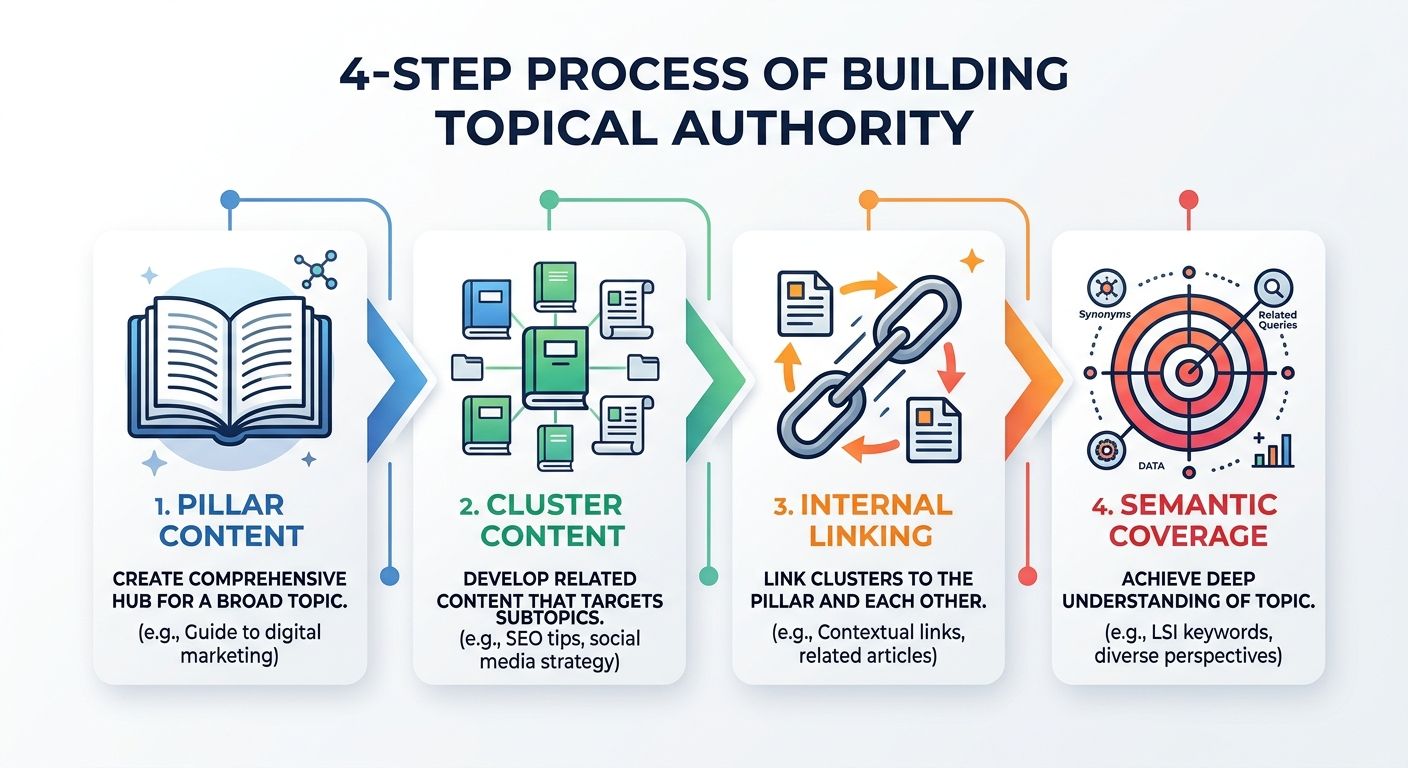
The 4-Step Framework to Build Topical Authority
Now that you know why Topical Authority matters, let us look at the exact step-by-step framework to build it.
Step 1: Choose a Specific Niche
Topical Authority is impossible if your website is about everything. You need to focus. If you write about health, fitness, finance, and technology, you are a generalist. You will never have high Topical Authority in any of them.
Instead, choose a specific sub-niche. Instead of health, write about vegan nutrition for athletes. Instead of finance, write about saving money for freelancers. You can use our Keyword Magic Tool to find high-volume, low-competition keywords in your niche.
Step 2: Create a Pillar Page
A pillar page is a long, comprehensive article that covers the main topic of your niche. It is usually 3000 to 5000 words long. It acts as the central hub for all your content.
For example, if your niche is vegan nutrition for athletes, your pillar page might be titled The Ultimate Guide to Vegan Nutrition for Athletes. It would cover the basics of protein, carbs, fats, and supplements. It would also link out to more detailed articles on each of these sub-topics.
Step 3: Create Cluster Content
Cluster content is the detailed articles that branch off from the pillar page. For each sub-topic in your pillar page, you write a separate article.
For example:
- Best Vegan Protein Sources for Athletes
- How to Create a Vegan Meal Plan for a Marathon
- Vegan Supplements for Muscle Recovery
- Common Mistakes in Vegan Bodybuilding
According to SEO experts, you should aim to write 15 to 30 cluster articles for every pillar page. This shows Google that you have covered the entire topic in depth.
Step 4: Link Everything Together (Internal Linking)
This is the most important step. If your pillar page and cluster pages are not linked together, Google will not see them as a single topic cluster.
Here is the linking structure you must follow:
- Every cluster page should link up to the pillar page.
- The pillar page should link down to every cluster page.
- Cluster pages can also link to each other where relevant.
Use descriptive anchor text. Do not use click here. You can use our Broken Link Checker to ensure your internal links are working correctly.
Topical Authority vs Domain Authority: A Quick Comparison
| Feature | Domain Authority (DA) | Topical Authority |
|---|---|---|
| What it measures | Overall website strength based on backlinks. | Depth of knowledge on a specific topic. |
| How to build it | Get backlinks from other websites. | Write a pillar page and 15-30 cluster articles. |
| Impact on small sites | Hard to compete with big sites. | Levels the playing field. Small sites can win. |
| Google's focus in 2026 | Secondary factor. | Primary factor. |
How to Measure Your Topical Authority
Unlike DA, there is no single number for Topical Authority. It is a concept. However, you can measure it indirectly through Google Search Console.
Here is how:
- Impressions: Are your impressions growing for keywords in your niche?
- Ranking Keywords: Are you ranking for more and more variations of your main topic?
- Average Position: Is your average position for niche keywords improving over time?
If you see these numbers growing, it means Google is starting to trust your website on that topic. You can also use our DA Checker to track your Domain Authority as a secondary metric.
Common Mistakes That Kill Topical Authority
- Writing about too many topics: If you jump from cooking to crypto to cars, Google will be confused. Stay in one lane.
- Thin content: Writing 500-word articles just to fill the cluster will not work. Each article must be 1500+ words and provide real value.
- Ignoring internal links: If your pages are not linked together, they are just isolated islands. Google needs to see the connections.
- Copying from AI: If your cluster articles are just AI-generated summaries, they will not add Information Gain. Google will see them as spam. You can read our guide on What is Information Gain in SEO to learn how to add unique value.
A Note from the Developer
"I once had a client with a DA of 12 who was trying to compete with a site that had a DA of 70. They were in the home brewing niche. The big site had one article about how to make beer. My client had 25 articles about every step of brewing, from choosing yeast to bottling. Today, my client ranks number one for the main keyword. The big site is on page 3. This is the power of Topical Authority. You do not need to be the biggest site; you just need to be the most knowledgeable one on your topic." — Habib Ur Rehman
Frequently Asked Questions (FAQ)
What is Topical Authority?
Topical Authority is a score that shows how much a website knows about a specific topic. It is built by creating many high-quality pages about related sub-topics and linking them together.
Is Domain Authority still important in 2026?
Domain Authority is still a useful metric for overall website strength, but it is no longer the most important factor. Google now prioritizes Topical Authority, which means a small site with deep knowledge can beat a big site with general content.
How long does it take to build Topical Authority?
Building Topical Authority takes time. It usually requires publishing 15 to 30 high-quality articles on a specific topic over 3 to 6 months.
Can I build Topical Authority with AI content?
You can use AI to research and outline, but the final content must be human-edited and include original data. Pure AI content lacks Information Gain and will not build Topical Authority.
Conclusion
The shift from Domain Authority to Topical Authority is the biggest change in SEO in the last decade. It means that small websites can finally compete with the giants. It means that knowledge beats money. It means that quality beats quantity.
Start by choosing a specific niche. Build a pillar page. Write cluster content. Link everything together. Do this consistently for six months, and you will see your traffic grow.
If you want to check your site's technical health, use our free Speed Checker and Broken Link Checker. Happy optimizing!
Sources & References
- Moz: Official definition and explanation of Domain Authority. Read Guide
- Search Engine Journal (2026): How to build Topical Authority for modern search. Read Report
- Google Search Central: Official guidance on E-E-A-T and Helpful Content. Read Guide
Explore More Free SEO Tools
Written and reviewed by: Habib Ur Rehman, Full-Stack Web Developer & SEO Specialist.
Last Updated: November 11, 2026.