How to Optimize for Conversational Search & AI Follow-Ups
Written by Habib Ur Rehman • Last Updated: November 11, 2026
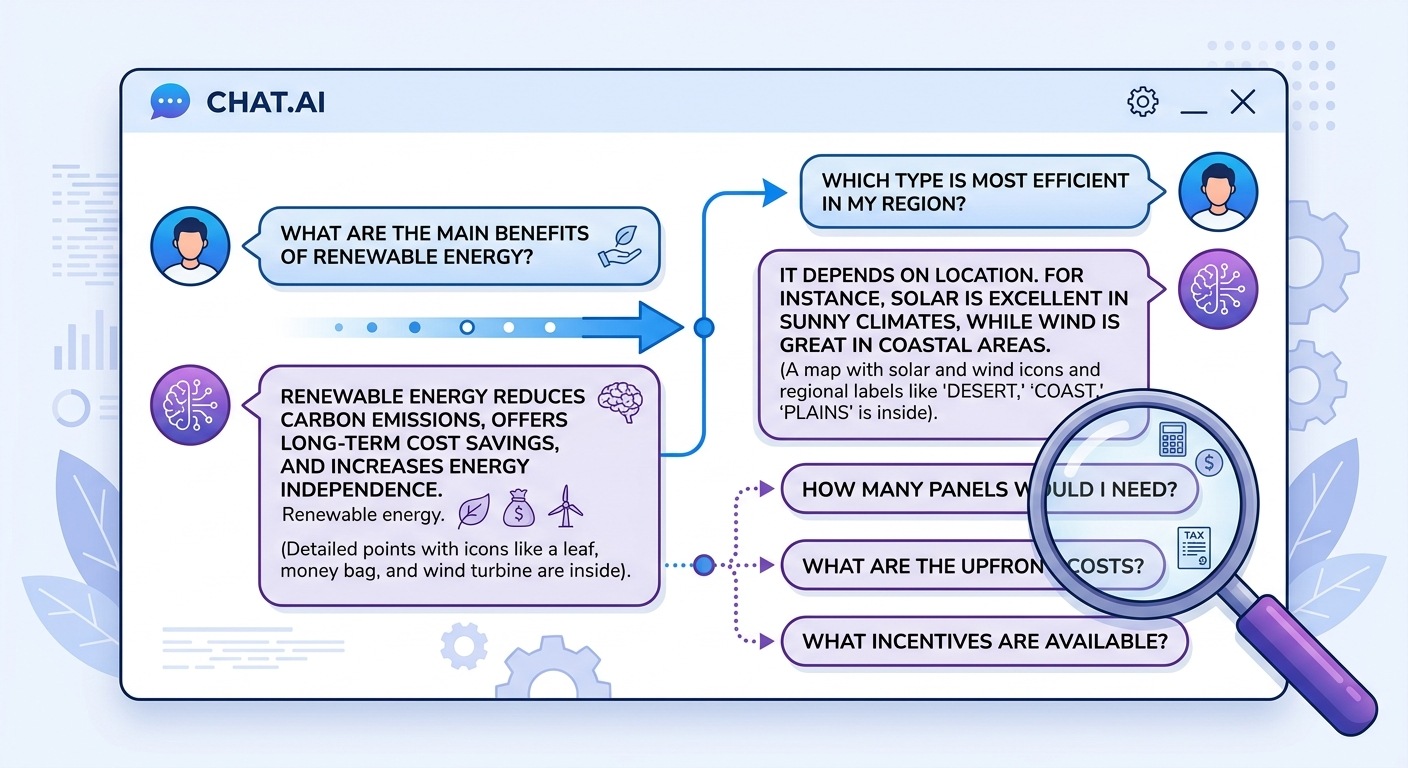
Quick Summary: Conversational search optimization is the process of structuring your content to answer not just the first question a user asks, but also the likely follow-up questions that AI systems will surface during a multi-turn conversation. Research shows that planning-related queries in Google AI Mode have grown 80% faster than overall queries. If your content only answers the first question, it will be ignored when the conversation moves to the next step. To win, you must pre-answer follow-ups, use question-based headings, and map the conversational thread for every key topic.
Hello! For the last twenty years, SEO has been built on a simple model: one query, one page. You find a keyword, you write a page optimized for that keyword, and you hope it ranks. But in 2026, that model is broken.
Google's AI Mode and conversational AI platforms like ChatGPT and Perplexity have changed user behavior. People no longer type a few words and leave. They ask a full question, read the AI's answer, and then ask a follow-up. Then another follow-up. And another. This is called a multi-turn conversation.
According to data from Search Engine Land, the most revealing search query is no longer the first one. It is the follow-up. If your website is not answering the follow-up questions, you are losing visibility at every step of the conversation.
In this advanced guide, I will explain exactly what conversational search optimization is, why it matters, and the exact framework to win in this new era. Let's dive in.
What is Conversational Search Optimization?
Conversational search optimization is the practice of structuring your content so that it can be the source of answers across an entire conversation, not just the first question. It means anticipating what the user will ask next and having the answer ready.
Think of it like this: In traditional SEO, you are trying to win a single race. In conversational search, you are trying to win a relay race. The user passes the baton from question to question, and your brand needs to be part of every leg of the race.
Google's AI Mode now supports follow-up questions with continuous context. The user does not need to start from scratch after each search. This means that if your page answers the first question but not the follow-up, the AI will look for a different source for the next step. You lose the conversation, and the competitor wins.
The Data: Why Follow-Up Questions Are the New Battleground
The numbers reveal a massive shift in user behavior that most SEOs are missing.
1. Planning Queries Are Exploding
According to a July 2026 report from Search Engine Journal, brainstorming-related queries in AI Mode have grown 30% faster than the overall pace. But the real explosion is in planning queries, which have grown 80% faster. Users are not just asking "what is X." They are asking "how do I plan for X," "what is the best way to do X," and "what should I do after X."
2. Repeat Searches Are Falling
A report from Progress in October 2026 found that repeat Google searches have fallen by around 20% in the U.S. This is because users are getting the answers they need from AI without refining their search. The conversation replaces the search refinement. If your content is not part of that conversation, you are invisible.
3. Long-Tail Question Queries Have Higher CTR
A 2026 study from RankRanger found that pages optimized for long-tail, question-based queries saw a 23% higher click-through rate from SGE results than traditional ten-blue-link listings. This means that even in a zero-click world, optimizing for conversational queries drives more clicks than traditional keyword optimization.
The Follow-Up Query Framework: How to Optimize
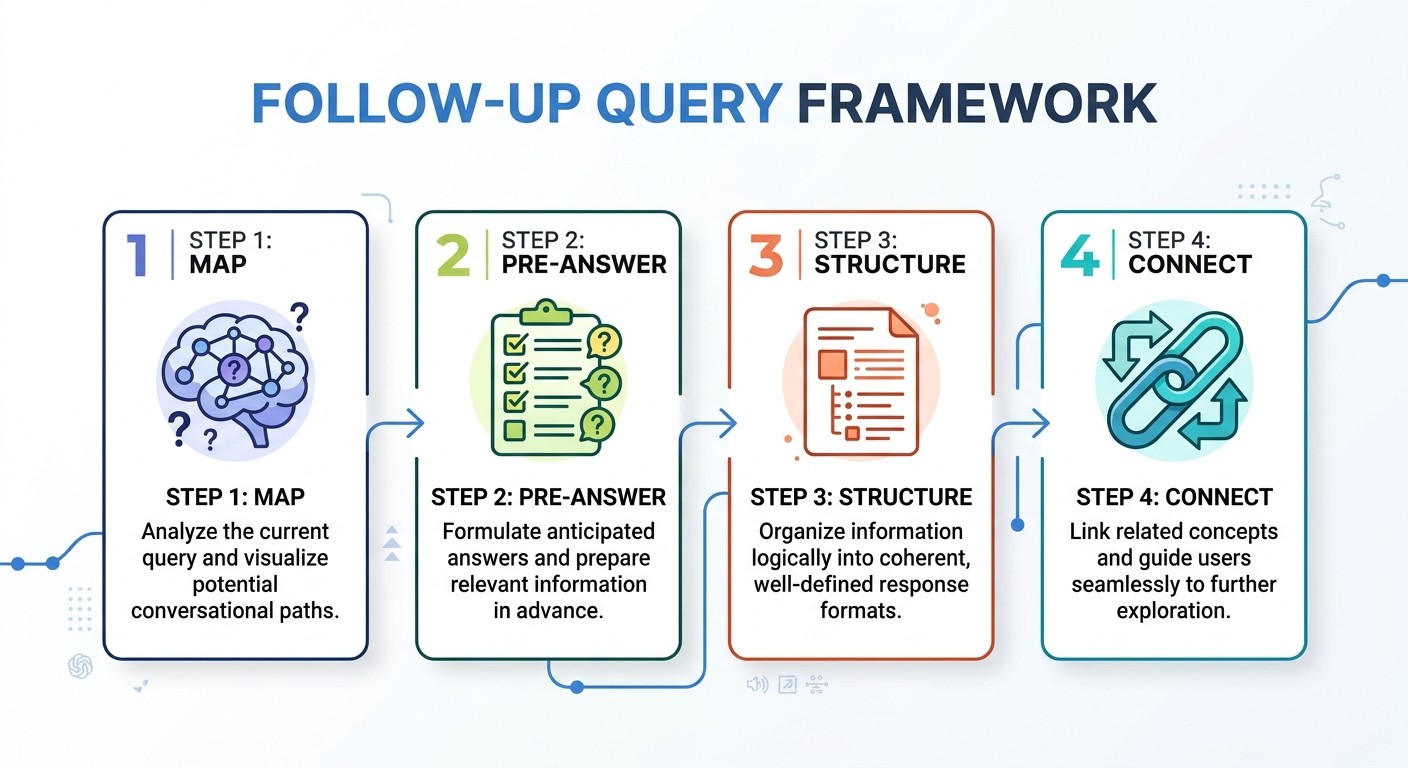
Now that you understand the problem, let's look at the exact step-by-step framework to solve it. I call it the Follow-Up Query Framework.
Step 1: Map the Likely Follow-Up Questions
Before you write a single word, you need to map the conversation. Start with your main keyword and then ask: What will the user ask next?
Here is how to find these questions:
- Ask ChatGPT or Perplexity directly: Type your main question and watch what follow-up suggestions the AI provides.
- Use Google's People Also Ask: Every time you click a question, it expands to show more questions. This is a goldmine of follow-up intent.
- Use AlsoAsked: This free tool visualizes the question hierarchy and shows you exactly how the conversation unfolds.
- Read Reddit and Quora: Look for threads where users ask a question and then follow up with "but what about..." or "how does that work if..."
For example, if your main keyword is "how to start a blog," the follow-up questions might be:
- How much does it cost to start a blog?
- Which blogging platform is best for beginners?
- How do I get traffic to a new blog?
- How long does it take to make money from a blog?
Step 2: Pre-Answer the Follow-Ups in Your Content
Once you have mapped the questions, you need to answer them. Do not wait for the AI to ask. Put the answer directly in your content.
The best way to do this is to use question-based headings. Instead of an H2 like "Cost of Starting a Blog," use an H2 like "How Much Does It Cost to Start a Blog?" This signals to AI that you are directly answering the question.
Here is the structure:
- H2: How much does it cost to start a blog?
- Immediate answer: It costs between $50 and $200 in the first year.
- Explanation: A breakdown of domain, hosting, and theme costs.
According to SEO vendor guides, you should aim to answer each follow-up in 40 to 60 words. This is the optimal length for AI extraction. If your answer is too long, the AI might skip it. If it is too short, it might not provide enough context.
Step 3: Structure Each Answer as an Extractable Chunk
AI models break your page into chunks. Each answer should be its own chunk. Use short paragraphs, bullet points, and clear formatting to make each answer easy to extract.
For example:
- Question: What is the best blogging platform for beginners?
- Answer: WordPress.org is the best platform for beginners because it is free, flexible, and has thousands of plugins. (40 words)
- Why: It offers full control over your content and SEO.
This format makes it easy for AI to pull the exact answer it needs for the follow-up question, without having to parse a long, rambling paragraph.
Step 4: Connect the Questions with Internal Links
Once you have answered the follow-ups, you need to connect them. If the conversation moves from "how to start a blog" to "how to get traffic," link from the first answer to the second. This builds a conversational cluster.
Google's John Mueller has confirmed that technical SEO, including internal linking, remains key for AI search. By linking your pages together, you are telling Google that you are an authority on the entire conversation, not just one question. You can use our Broken Link Checker to ensure your internal links are working correctly.
Advanced Tactics for Conversational Search
Here are some advanced tactics to take your conversational search optimization to the next level.
1. Use "Query Fan-Out" to Find Hidden Questions
Query fan-out is a concept where AI systems break your main query into multiple sub-queries and execute them in parallel. According to Yext, understanding how conversations unfold in your category is critical. You can use this to your advantage by identifying the sub-queries AI generates and answering them all on one page.
2. Add Comparison and "Versus" Sections
In conversational search, users often ask "what is the difference between X and Y." If your page has a dedicated comparison section, it is much more likely to be cited. For example, if you write about "SEO tools," add a section called "Ahrefs vs Semrush: Which is Better for Beginners?" You can use our Meta Tag Generator to create FAQ schema for these sections.
3. Optimize for "Why," "How," and "Versus" Queries
According to Semantica AI, these three query types are the backbone of conversational search. Make sure every major page on your site has sections that answer "why" (why is this important), "how" (how do I do this), and "versus" (how does this compare to alternatives). This is the exact structure that AI models are trained to look for.
4. Prepare for Agentic Commerce
Google's AI Mode is moving toward agentic commerce, where the AI completes tasks for the user. To prepare, you need to make your product and service pages easy for AI to read and act on. This includes clear pricing, structured data, and simple forms. You can read our full guide on Agentic Search for more details.
A Note from the Developer
"When I first started optimizing for conversational search, I thought it was just about adding FAQs. But I was wrong. I tested a page that answered the first question perfectly but ignored the follow-ups. AI Mode would cite my page for the first answer, then immediately switch to a competitor for the second. I restructured the page to answer three follow-up questions directly in 40-word chunks. Within two weeks, my page was cited for the entire conversation. The key is not just to answer the first question, but to own the entire thread." — Habib Ur Rehman
Frequently Asked Questions (FAQ)
What is conversational search optimization?
Conversational search optimization is the process of structuring your content to answer not just the first question a user asks, but also the likely follow-up questions that AI systems will surface during a multi-turn conversation.
Why are AI follow-up questions important for SEO?
Research shows that planning-related queries in AI Mode have grown 80% faster than overall queries. If your content only answers the first question, it will be ignored when the conversation moves to the next step.
How do I find the follow-up questions my audience asks?
Ask ChatGPT or Perplexity a question about your topic and watch the suggested follow-up questions. Also use Google's People Also Ask section and tools like AlsoAsked to map the conversational thread.
What is the ideal length for a follow-up answer?
Aim for 40 to 60 words. This is the optimal length for AI extraction. It provides enough context without being too long to parse.
Conclusion
Conversational search is not a future trend. It is happening right now. The SEOs who understand that the follow-up question is the new battleground will win. The ones who are still optimizing for a single keyword will be left behind.
By following the Follow-Up Query Framework—mapping the questions, pre-answering them, structuring them for extraction, and connecting them together—you can ensure your brand owns the entire conversation.
If you want to check your site's technical health, use our free Speed Checker and Broken Link Checker. Happy optimizing!
Explore More Free SEO Tools
Written and reviewed by: Habib Ur Rehman, Full-Stack Web Developer & SEO Specialist.
Last Updated: November 11, 2026.