The Almost Ranking Method: Push from Page 2 to Page 1 (2026)
Written by Habib Ur Rehman • Last Updated: November 11, 2026
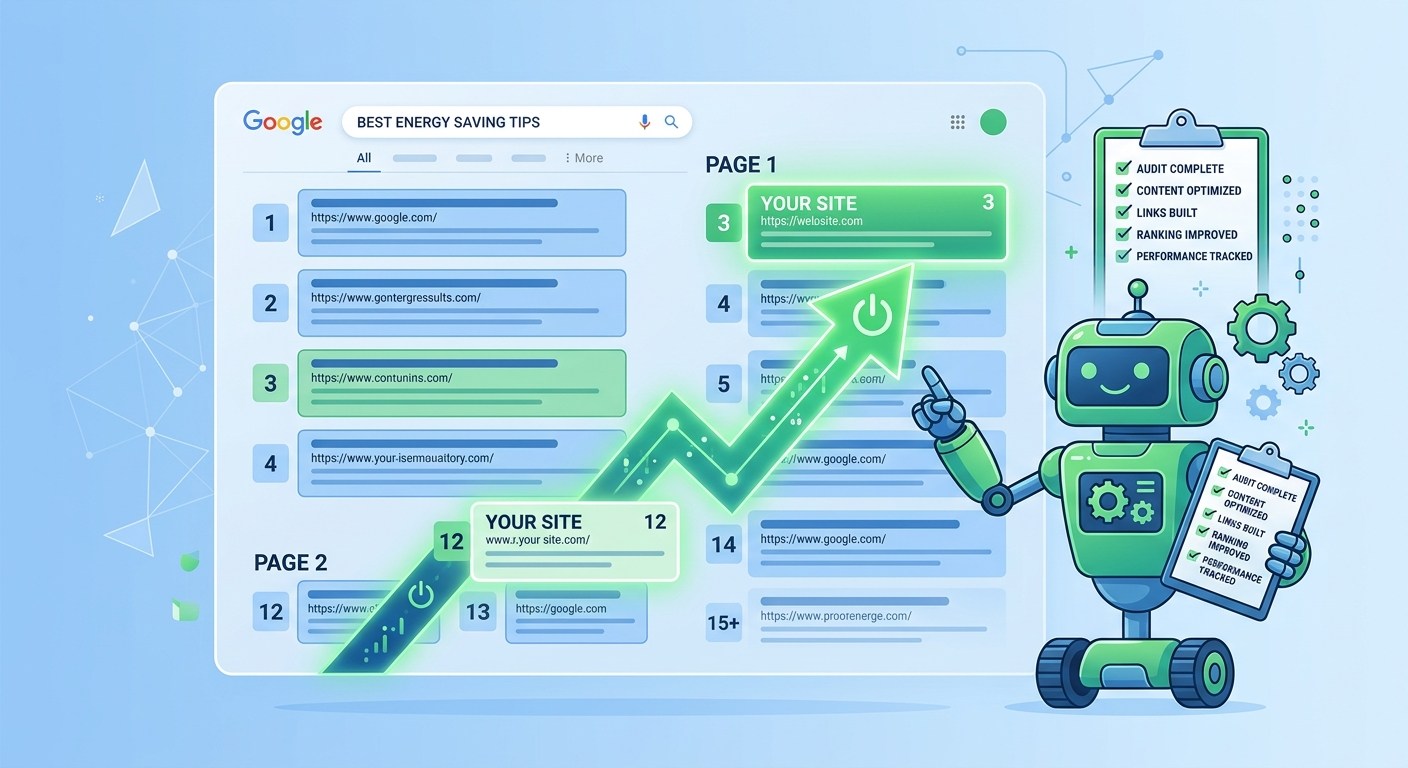
Quick Summary: The Almost Ranking Method is a proven SEO strategy that focuses on keywords where your website already ranks on page 2 (positions 11-20). Instead of chasing new, difficult keywords, you optimize existing pages to push them to page 1. This is faster because Google already trusts your page enough to rank it near the top. This guide gives you the exact 5-step framework to identify, optimize, and rank these almost-ranking pages in 2026.
Hello! If you are tired of writing new articles and waiting months for them to rank, you are not alone. Most website owners spend 80% of their time creating new content and only 20% optimizing what they already have. This is a huge mistake.
The fastest way to grow your organic traffic is not to chase new keywords. It is to find the keywords where you are already ranking on page 2 and push them to page 1. This is called the Almost Ranking Method.
According to a 2026 framework by Rizwan Saeed, who tested over 100 websites, 80% of sites fail to use this method. One client went from position 23 to position 3 in just 14 days after fixing only 8 on-page checks. In this detailed guide, I will give you the exact 5-step process to do this for your own website.
What is the Almost Ranking Method?
The Almost Ranking Method is an SEO strategy that focuses on keywords where your website is already ranking on page 2, specifically in positions 11 to 20. Instead of trying to rank a brand new page for a difficult keyword, you take a page that is almost there and make small, targeted improvements to push it to page 1.
Think of it like this: Imagine you are running a race and you are in 12th place. You are close to the top 10. A small burst of speed will get you into the top 10. But if you start from 100th place, you need a massive effort to reach the top 10. The Almost Ranking Method is about finding your 12th place pages and giving them that small burst of speed.
Why Does the Almost Ranking Method Work?
This method works because of one simple fact: Google already trusts your page. When Google ranks your page in position 12, it means Google has crawled it, indexed it, and decided it is relevant to the query. It is not spam. It is not penalized. It is just not quite as good as the pages in the top 10.
According to data from the LinkedIn framework, if a page is ranking in position 11-20, a small improvement in content quality, on-page SEO, or internal links can push it to page 1. This is much easier than ranking a brand new page, which has no history, no trust, and no backlinks.
Another reason this method works is that it uses data you already have. You are not guessing which keywords to target. You are looking at Google Search Console and finding the keywords where you are already getting impressions but not clicks. This is the lowest-hanging fruit in SEO.
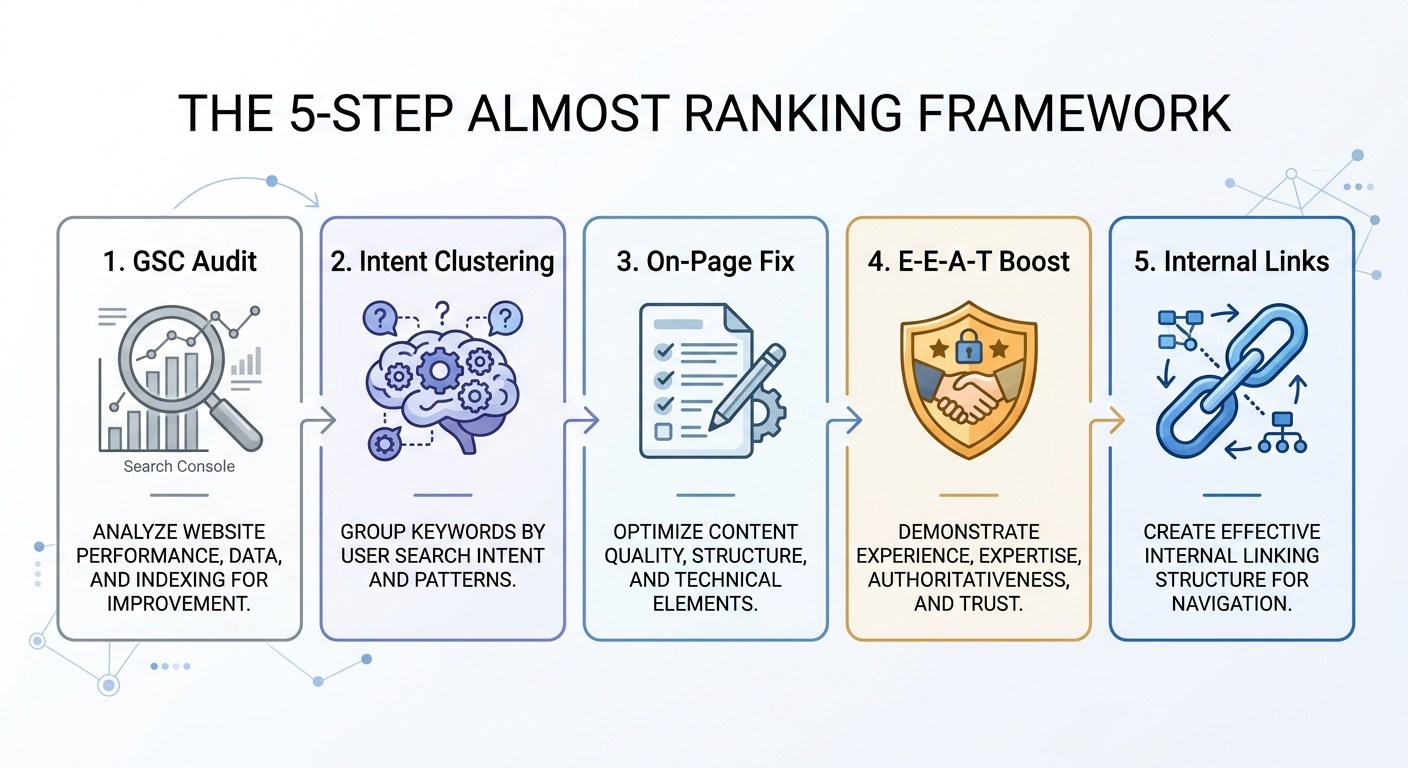
The 5-Step Almost Ranking Framework
Here is the exact step-by-step framework to implement the Almost Ranking Method on your website.
Step 1: Export 16 Months of Google Search Console Data
The first step is to get the data. Go to Google Search Console and open the Performance report. Set the date range to the last 16 months. This gives you enough data to see trends and find keywords that have been consistently ranking on page 2.
Click the Export button and download the data as a CSV file. You will now have a spreadsheet with every keyword your site is ranking for, along with impressions, clicks, average position, and click-through rate.
Step 2: Filter for Keywords in Positions 11 to 20
In your spreadsheet, apply a filter to the Average Position column. Set it to show only keywords with an average position between 11 and 20. These are your Almost Ranking keywords.
Now, sort these keywords by Impressions (highest to lowest). You want to focus on the keywords that get the most searches, because moving them to page 1 will bring the most traffic.
According to the framework, one site found 340 missed keywords using this method and added only 3 blogs, which resulted in a 120% traffic increase in 45 days.
Step 3: Group Keywords by Search Intent
Do not just look at keywords one by one. Group them by search intent. This is critical for creating content that actually satisfies the user.
- Informational (blog posts): How to, what is, guide.
- Commercial (comparison): Best, vs, review.
- Transactional (product): Buy, price, discount.
The framework notes that grouping by intent prevents cannibalization (where two pages compete for the same keyword). If you have multiple keywords with the same intent, map them to the same page. You can use our Keyword Magic Tool to help find related keywords.
Step 4: Fix On-Page SEO (The 8 Checks)
This is where the magic happens. For each Almost Ranking page, you need to fix the following on-page elements. These are the exact checks that took one page from position 23 to position 3.
| Element | Best Practice |
|---|---|
| Title Tag | 55-60 characters, primary keyword first, compelling. |
| Meta Description | 150-155 characters, include a clear Call to Action (CTA). |
| H1 Tag | Only one H1, matches search intent. |
| H2/H3 Structure | Logical flow, answers sub-questions. |
| Internal Links | 3-5 links per 1000 words, descriptive anchor text. |
| FAQ Schema | 3-4 questions with FAQPage schema markup. |
| Images | Original images with descriptive alt text. |
| Video | Embed a Loom video or custom video to increase dwell time. |
Fixing these 8 checks alone took one page from position 23 to position 3 after just these 8 checks. You can use our Meta Tag Generator to create perfect title tags and meta descriptions.
Step 5: Boost E-E-A-T and Authority
The final step is to show Google that your content is trustworthy. This is especially important for competitive keywords. The framework recommends the following:
- Add an author bio with real credentials (e.g., "Habib Ur Rehman, Full-Stack Web Developer").
- Cite credible sources (like Google, Moz, or industry studies).
- Add case studies with real data.
- Include client testimonials or review schema.
Google loves real experience. If you can prove that you have actually used a product or conducted a test, you gain information that Google values. You can learn more in our guide on What is Information Gain in SEO.
What NOT to Do After a Core Update
- Do not delete all your content: This is a common panic reaction. Unless the content is truly terrible, do not delete it. Improve it instead.
- Do not buy backlinks: This will not help and can make things worse.
- Do not use AI to spam content: Google is very good at detecting low-quality AI content. You can use AI for research and outlines, but the final content should be human-edited and add unique value.
A Note from the Developer
"I used to spend all my time writing new articles. I had 50 posts, but only 5 were ranking. I was frustrated. Then I discovered the Almost Ranking Method. I exported my GSC data and found 40 keywords where I was ranking in position 11-20. I did not write a single new article for a month. I just optimized those 40 pages using the 8 on-page checks. Within six weeks, 22 of them moved to page 1. My traffic doubled without writing anything new. This is the most underrated SEO strategy in 2026." — Habib Ur Rehman
Frequently Asked Questions (FAQ)
What is the Almost Ranking Method?
The Almost Ranking Method is an SEO strategy that focuses on keywords where your website already ranks on page 2 (positions 11-20). Instead of chasing new keywords, you optimize existing pages to push them to page 1.
Why focus on page 2 instead of new keywords?
Because Google already trusts your page enough to rank it on page 2. A small improvement in content quality, on-page SEO, or internal links can push it to page 1. It is faster than ranking a brand new page.
How long does it take to see results?
It can take 2 to 6 weeks for Google to re-evaluate the page. Results depend on the competition and the quality of your improvements.
Do I need backlinks to rank from page 2 to page 1?
Not always. Many almost-ranking keywords can be pushed to page 1 with on-page SEO alone. However, for highly competitive keywords, a few strong internal links or external mentions can help.
Conclusion
The Almost Ranking Method is the fastest way to grow your organic traffic. It is based on data you already have, and it does not require you to write new content. By following the 5-step framework, you can take your page 2 keywords and push them to page 1.
Start by exporting your GSC data today. Filter for positions 11-20. Fix the 8 on-page checks. Boost your E-E-A-T. And watch your traffic grow.
If you want to check your site's technical health, use our free Speed Checker and Broken Link Checker. Happy optimizing!
Sources & References
- Rizwan Saeed (August 2026): LinkedIn framework on the Almost Ranking Method. View Post
- Google Search Central: Official documentation on Search Console performance reports. Read Guide
- Neil Patel (October 2026): Defensible GEO opportunities for smaller brands. Read Study
Explore More Free SEO Tools
Written and reviewed by: Habib Ur Rehman, Full-Stack Web Developer & SEO Specialist.
Last Updated: November 11, 2026.