What is Entity Salience in SEO?
Written by Habib Ur Rehman • Last Updated: November 11, 2026

Quick Summary: Entity Salience is a concept in Natural Language Processing (NLP) used by Google to determine how prominently a specific "thing" (an entity like a person, place, or concept) is featured within a piece of text. Instead of just counting keywords, Google tries to understand the main subject of your page. If your content is highly focused on a specific entity and mentions related entities naturally, your "Entity Salience" for that topic is high, which can lead to better rankings in modern semantic search.
The Evolution of Search: From Strings to Things
For over a decade, SEO was largely about "strings" – specific combinations of letters (keywords) that users typed into the search bar. If you wanted to rank for "best coffee maker," you made sure the exact phrase "best coffee maker" appeared on your page a certain number of times.
But around 2012, Google introduced the Knowledge Graph and the Hummingbird algorithm. This was a massive paradigm shift. Google stopped just matching strings (keywords) and started trying to understand "things" (entities).
Today, Google uses highly advanced Artificial Intelligence (AI), Natural Language Processing (NLP), and machine learning models like BERT and MUM to read a page much like a human does. It doesn't just see the word "Apple"; it understands whether you are talking about the fruit, the tech company, the record label, or the movie.
This brings us to the core of modern advanced SEO: Entity Salience. If you understand this, you are playing a completely different (and much more effective) game than 90% of bloggers who are still stuck on keyword density.
What is an Entity in SEO?
Before we dive into "salience," we need to clearly define an "entity." In the context of search engines, an entity is a distinct, unique, and well-defined thing. It is an object, a concept, a person, a place, or a brand that exists in the real world.
Google stores these entities in its massive database called the Knowledge Graph. Every entity has a unique ID, attributes, and, most importantly, relationships with other entities.
Examples of Entities:
- People: Elon Musk, Cristiano Ronaldo, Marie Curie.
- Places: Eiffel Tower, New York City, Mount Everest.
- Things (Products/Objects): iPhone 15, Coca-Cola, PlayStation 5.
- Concepts (Abstract): Search Engine Optimization, Democracy, Quantum Physics.
When you write an article, you are not just writing words; you are weaving a web of entities. For example, if you write an article about "How to train a Golden Retriever," the primary entity is the Golden Retriever. The related entities might be dog training, leash, treats, obedience, etc.
Defining Entity Salience
Now that we know what an entity is, what is "salience"? In NLP, salience refers to the state of being prominent, important, or standing out.
Entity Salience is a metric used by search engines to understand which specific entity (or entities) is the most important subject of a given webpage or document.
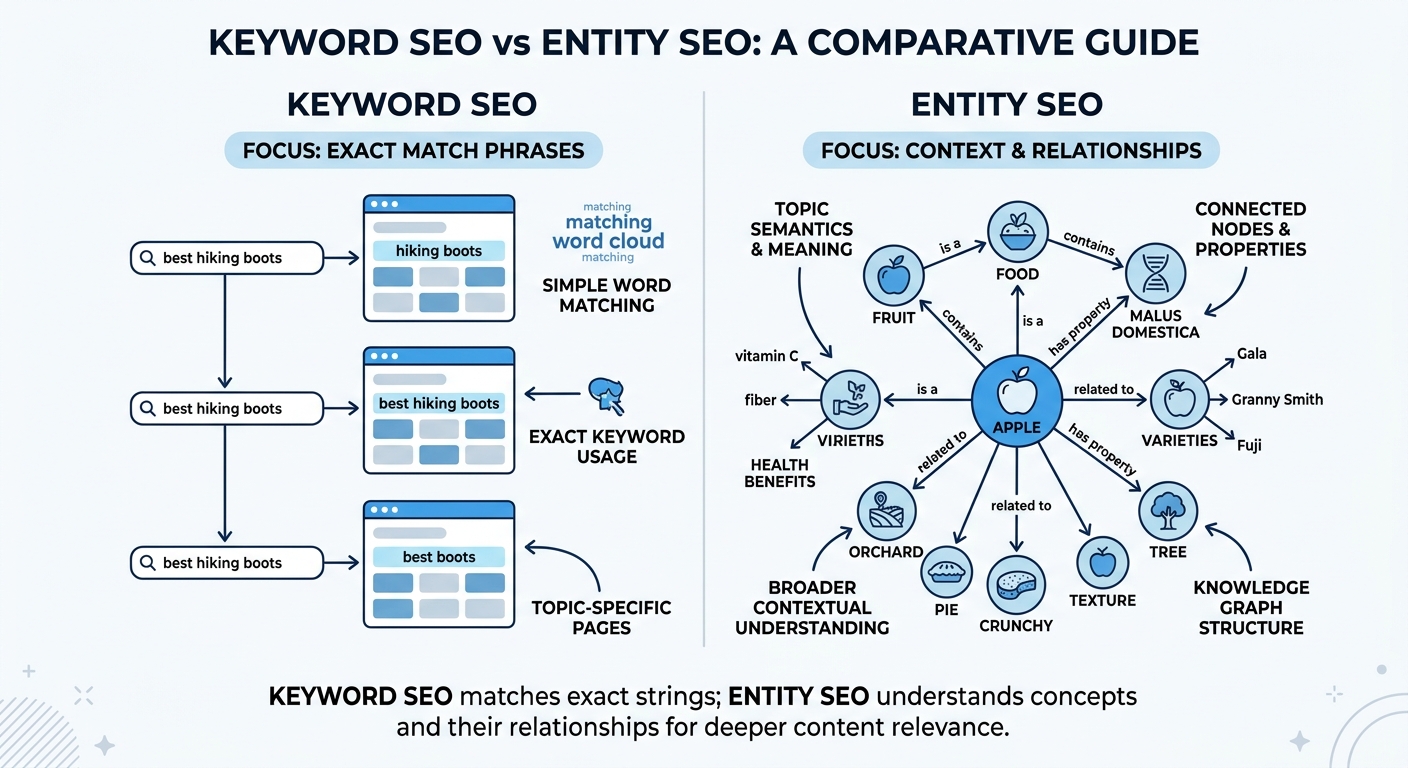
Imagine you have a document about "Apple." If the text mostly talks about orchards, picking apples, apple pie, and Granny Smith, the most salient entity is the fruit. If the text talks about iPhones, Tim Cook, Macbooks, and iOS, the most salient entity is the tech company.
Google's algorithms try to calculate the salience of every entity on your page to determine what your page is actually about. If your page's salience is confused (e.g., it mixes up the fruit and the tech company), Google might hesitate to rank it for either.
Entity Salience vs. Keyword Density
To truly understand the shift in SEO, it's crucial to compare Entity Salience with the old standard: Keyword Density.
| Feature | Keyword Density | Entity Salience |
|---|---|---|
| Focus | Counting exact word matches. | Understanding meaning and context. |
| Measurement | (Keyword Count / Total Words) x 100. | Based on NLP, related terms, and prominence. |
| Weakness | Easily manipulated by keyword stuffing; ignores synonyms. | Requires deep, contextual writing. |
| Modern Relevance | Low (Outdated). | Very High (Future of SEO). |
If you write an article about the "Tech Giant Apple," you don't need to write the word "Apple" 50 times. Instead, you mention the iPhone, Macbook, iOS, Steve Jobs, and the App Store. Google's NLP sees these related entities and understands that the main entity is the tech company. The salience is high and accurate.
How Google Calculates Entity Salience
Google doesn't publicly share its exact formula, but SEO experts and data scientists have reverse-engineered several factors that influence how Google calculates entity salience:
1. Prominence (Frequency and Placement)
Just like old-school keywords, entities mentioned more frequently are considered more salient. However, the placement is also crucial. If an entity is mentioned in the H1 title, the first paragraph, and several H2 subheadings, its salience score increases significantly.
2. Co-occurrence (The Context)
This is the secret sauce. Google looks at how often your main entity appears alongside other specific entities. If you are writing about "Apple," and the words "Tim Cook" and "iPhone" appear frequently, the algorithm recognizes that the context is Technology, not Fruit.
3. Structural Markup
Using Schema.org structured data explicitly tells Google what entities are on the page. By using Product, Person, or Organization schema, you are directly boosting the salience of those entities in the eyes of the search engine.
4. Contextual Relevance (TensorFlow and BERT)
Google's neural networks (like BERT) analyze the relationship between every word in a sentence. They look at the surrounding words to determine the exact meaning of an ambiguous entity in that specific context.
Why Entity Salience Matters for Ranking
Why should you, as a website owner or SEO specialist, care about this complex concept? Because the rules of the game have changed.
Google is no longer ranking pages based on exact keyword matches. It is trying to answer the user's query. If the user searches for "Who is the CEO of the company that makes the iPhone?", Google doesn't want a page that says "CEO" 50 times. It wants a page that clearly connects the entities: iPhone -> Apple -> Tim Cook.
Pages with high and accurate entity salience are deemed "authoritative" on a topic. When Google understands that a page is specifically about a certain entity, it is much more likely to rank that page for related queries. It helps Google understand your page's "Topical Authority."
How to Optimize Your Content for Entity Salience
Now for the practical part. How do you actually implement this advanced strategy on your website to improve your rankings? Here is a step-by-step advanced SEO guide.
Step 1: Identify Your Core Entity
Before writing, decide what the absolute main subject of your article is. Is it a person? A product? A concept? For this article, the core entity is "Entity Salience." Everything you write must revolve around it.
Step 2: Map Related Entities (Semantic SEO)
Once you have your main entity, brainstorm a list of 10-20 related entities. You can do this by searching for your main entity on Google and looking at the "People Also Ask" section, "Related Searches," or by looking at Wikipedia pages.
Example: If your core entity is "Content Marketing," related entities would be: Copywriting, SEO, Blogging, Lead Generation, Social Media, Email Marketing.
Step 3: Use NLP-Friendly Formatting
Write short, clear sentences. Use bullet points and numbered lists. Answer questions directly. This makes it extremely easy for Google's NLP models to extract meaning and understand the relationships between entities in your text.
Step 4: Build a Topical Cluster
Don't just write one article and stop. If your main entity is "Entity Salience," write supporting articles about "Knowledge Graph Optimization," "Natural Language Processing in SEO," and "Schema Markup." Interlink all these articles. This builds a "Topical Cluster" that strongly signals to Google that you are an authority on the broader topic.
Step 5: Leverage Schema Markup
Use JSON-LD structured data to explicitly define your entities. If you are writing about a Product, use Product schema. If you are writing about a Person, use Person schema. This provides machine-readable data that gives an immediate boost to entity salience. You can use our Meta Tag Generator to help with basic schema, though advanced custom schemas might require a developer.
Step 6: Link to Authoritative Sources
Outbound links to high-authority sites (like Wikipedia, major universities, or official industry documentation) about your entities help Google verify the context of your page. It acts as a "citation."
Common Myths About Entity SEO
As this is a relatively new area, several myths have popped up that you should avoid.
- Myth: You should stop using keywords entirely. Fact: Keywords are still important. They are the "strings" that point to the "things." You just shouldn't obsess over exact-match density. Write naturally, and keywords will appear.
- Myth: Entity salience only matters for massive brands. Fact: While big brands have strong entities due to their size, small sites can build high entity salience by creating very focused, deep content around a niche subject.
- Myth: You can trick Google's NLP. Fact: You can't. Google's algorithms are too advanced. If you write a page that claims to be about "Apple" but is actually just a spam page, the NLP will easily detect the lack of relevant entities (like iOS or Mac) and the page won't rank.
A Note from the Developer
"When I first started doing SEO, I was obsessed with the Keyword Density Checker. I would try to hit exactly 1.5% for my main keyword. It worked for a while, but then I noticed my sites started losing rankings. The game had changed. Once I started focusing on entities—writing deeply about a topic and mentioning related concepts—my rankings became much more stable. Entity SEO is harder to write, but it's much more rewarding." — Habib Ur Rehman
Tools to Help You with Entity Salience
To get started with this advanced strategy, you can use a few free tools:
- Google NLP API (Natural Language API): You can use Google's own cloud tool to analyze your text. It will give you a "Salience Score" (from 0 to 1) for each entity it detects in your content. This is the most accurate way to see how Google sees your page.
- Google Knowledge Graph Search API: Use this to find the IDs for the entities you are writing about.
- Our Keyword Magic Tool: While traditionally a keyword tool, use it to find "semantic keywords" and related search terms that point to the same entity.
Frequently Asked Questions (FAQ)
What is an entity in SEO?
An entity is a distinct, unique thing, person, place, or concept that Google understands and stores in its Knowledge Graph. Examples include 'Apple', 'Barack Obama', or 'Eiffel Tower'.
What is the difference between keyword density and entity salience?
Keyword density counts how many times a specific word appears on a page. Entity salience measures how prominently Google's NLP algorithms think a specific concept or 'thing' is discussed on the page, based on context and related terms.
How can I improve entity salience on my page?
You can improve it by clearly defining the main entity in the title and first paragraph, using related entities (co-occurrence), using proper structured data (Schema), and linking to authoritative sources about that entity.
Is entity salience only for technical SEOs?
While the concept sounds technical, the application is simple. It just means writing naturally and comprehensively about a subject, rather than stuffing a single keyword. Any writer can do it.
Conclusion
Entity Salience is a complex but incredibly powerful concept. It represents the shift from a search engine that matches words to one that understands meaning. By optimizing your content for entities, you are future-proofing your website against algorithm updates and building a strong foundation for long-term SEO success.
If you want to ensure your technical SEO is as strong as your content, use our free Speed Checker to make sure your site loads fast, and our DA Checker to see your site's overall authority. Happy optimizing!
Explore More Free SEO Tools
Written and reviewed by: Habib Ur Rehman, Full-Stack Web Developer & SEO Specialist.
Last Updated: November 11, 2026.