Introduction
In the world of Search Engine Optimization (SEO), content is king. But even the best content can be ruined if it is not optimized correctly. One of the oldest, yet most misunderstood concepts in on-page SEO is Keyword Density.
If you have been blogging for a while, you might have heard conflicting advice. Some "gurus" say you need to repeat your keyword as many times as possible to rank. Others say keyword density is dead. Both extremes are wrong.
The truth lies in the middle. While Google's algorithms have become incredibly smart, understanding how to check keyword density and maintaining a natural flow is still crucial. If you stuff too many keywords, you risk a penalty. If you use too few, Google might not understand what your page is about.
In this comprehensive guide, we will teach you exactly how to check keyword density, what the ideal percentage is, and how to use our free keyword density analysis tool to write content that ranks.
What is Keyword Density?
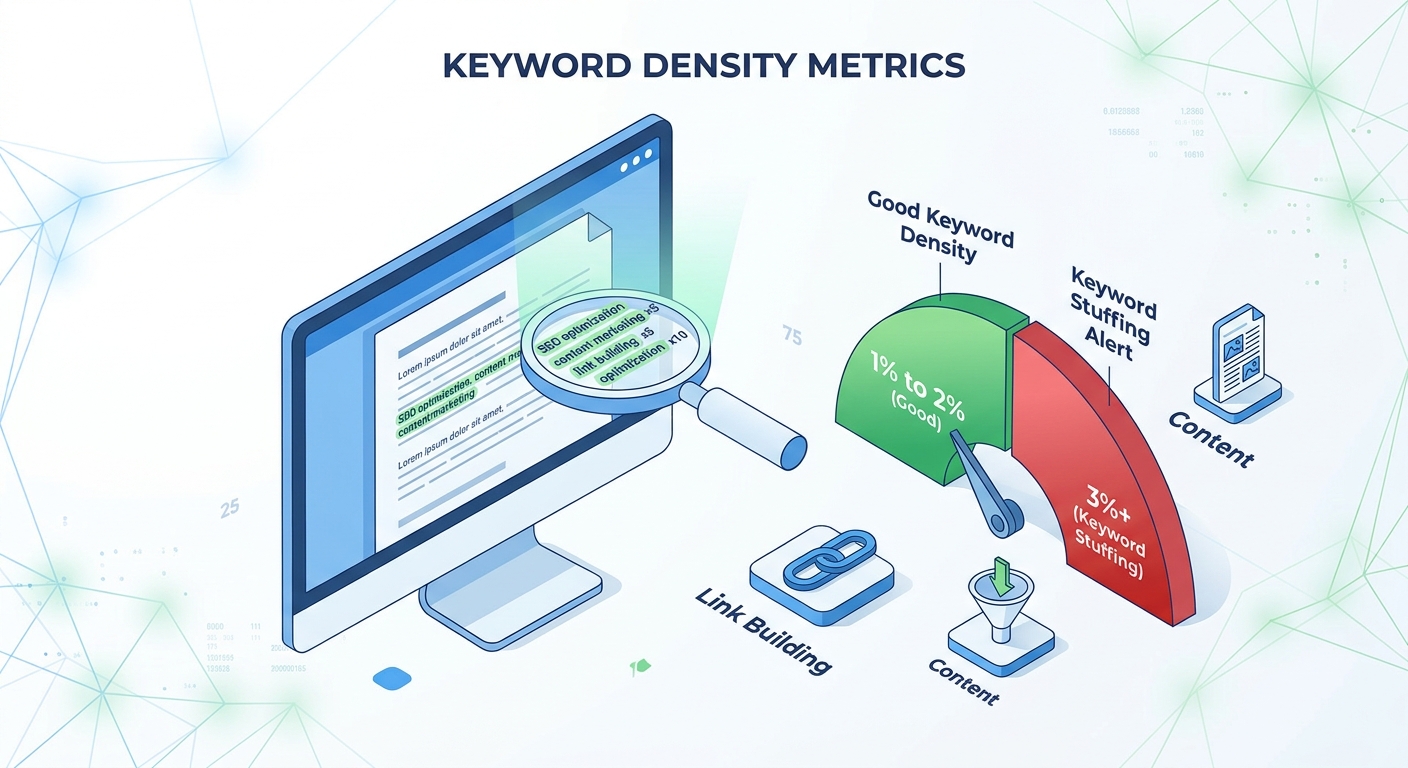
Keyword density is the percentage of times a specific keyword or phrase appears on a web page compared to the total number of words on that page.
For example, if you have a 1,000-word article and your main keyword appears 10 times, your keyword density is 1%.
In the early days of SEO (around 2005-2010), search engines relied heavily on exact keyword matching. If you wanted to rank for "best coffee maker," you had to repeat that phrase dozens of times. However, Google's Hummingbird and RankBrain updates changed everything. Today, Google uses Natural Language Processing (NLP) to understand the context of your content, not just the exact words.
Is Keyword Density Still a Ranking Factor in 2026?
This is a hotly debated topic. The short answer is: No, Google does not have a specific "Keyword Density" ranking algorithm. They don't look for exactly 1.5%.
However, keyword stuffing is still a spam violation. If your content reads like a robot wrote it—repeating the same phrase over and over—Google will penalize you. So while the exact percentage isn't the ranking factor, the natural language that a healthy density represents is vital.
How to Check Keyword Density for Free (Step-by-Step)
You don't need to do math manually. To check keyword density accurately, you should use a tool. At SEO Review Kit, we offer a powerful Keyword Density Analyzer that works instantly in your browser.
Here is how to check keyword density using our tool:
- Go to our Free Keyword Density Checker.
- Paste your entire article text into the input box. (Don't worry, our tool is 100% private and runs entirely in your browser; we never save your text).
- The tool will instantly generate a table showing your total word count, character count, and reading time.
- Look at the "Top Keywords Analysis" table. It will show you your most used words, their count, and their density percentage.
What is the Ideal Keyword Density?
If Google doesn't care about the exact percentage, why should you? Because it is a great warning system for over-optimization.
Here is the general consensus for a word density checker result:
| Density Percentage | Status | What You Should Do |
|---|---|---|
| 0% - 0.5% | Too Low | Google may not understand your topic. Add the keyword to your H1, intro, and H2s. |
| 1% - 2% | Perfect (Good) | This is the sweet spot. It is natural and relevant. |
| 2.5% - 3% | Borderline | Start using synonyms and pronouns instead of exact match. |
| Above 3% | Keyword Stuffing | Red Flag! Google may penalize this. Rewrite the text immediately. |
Note: The ideal percentage can vary slightly based on the length of your keyword. For a 1-word keyword, 1-2% is good. For a 4-word long-tail keyword, even 0.5% is excellent.
How to Fix Keyword Stuffing
If you ran your text through our keyword stuffing checker and found that your density is above 3%, don't panic. Here is how to fix it without rewriting the whole article:

1. Use Synonyms and LSI Keywords
Instead of repeating "best coffee maker," use words like "top espresso machine," "brewing device," or "coffee gadget." Google's AI understands that these mean the same thing.
2. Use Pronouns
If you are talking about a "Domain Authority Checker," the next time you mention it, just call it "the tool," "this utility," or "it." This drastically reduces your exact-match density while keeping the text natural.
3. Rephrase the Sentence
Instead of saying: "Our DA checker is the best DA checker because this DA checker is free."
Say: "Our Domain Authority tool is highly rated because it provides accurate results completely for free."
4. Rely on Context (NLP)
If you write a 2,000-word article about "Organic Coffee," Google knows what the article is about even if you only use the word "Organic Coffee" 5 times, as long as you use related terms like "beans," "roasting," "caffeine," and "fair trade."
Common Mistakes to Avoid
- Focusing only on the Main Keyword: Don't ignore secondary keywords. Our tool shows you the top 10 words, which helps you see if you are overusing secondary words.
- Stopping Natural Flow: Never sacrifice readability just to hit a percentage. If it sounds robotic to a human, it will sound robotic to Google.
- Stuffing in Meta Tags: Keyword stuffing doesn't just happen in the body. Don't stuff your meta title and meta description either. Use our SERP Simulator to ensure your titles look natural.
Frequently Asked Questions (FAQs)
How do I check keyword density?
To check keyword density, simply paste your text into our free keyword density analysis tool above. It instantly calculates the frequency of each word and shows you the density percentage.
What is a healthy word density checker result?
A healthy keyword density is generally between 1% to 2%. Anything above 3% is usually flagged as keyword stuffing by our tool and search engines.
Is my text stored on your server?
No. This keyword density tool seo runs entirely in your browser using JavaScript. Your content is never sent to our servers, ensuring 100% privacy.
Does Google penalize keyword stuffing?
Yes. Google's spam policies specifically target keyword stuffing. It can lead to your page being ignored or ranked lower. Always prioritize readability.
Conclusion
Understanding how to check keyword density is an essential part of on-page SEO. While you shouldn't obsess over hitting an exact number, ensuring your density stays between 1% and 2% is the easiest way to avoid keyword stuffing penalties and keep your content readable.
Ready to analyze your article? Go to our Free Keyword Density Checker right now, paste your content, and make sure it's perfectly optimized for both Google and your readers.